4 minute read · Brand comparison
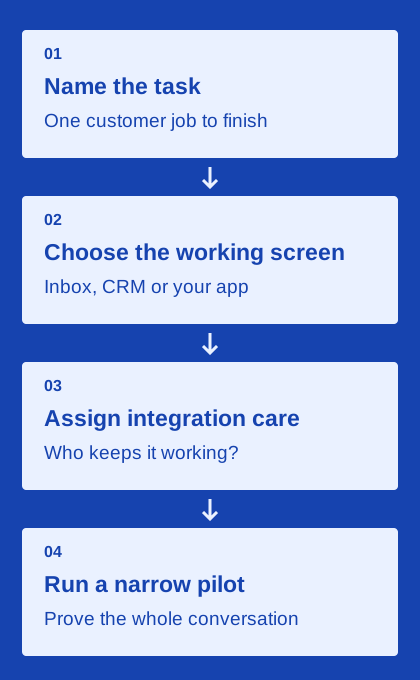
This is a different category from a managed business line
BlueBubbles and OpenBubbles are relevant to people who want iMessage access across devices and to builders exploring how a personal messaging setup works. They should not automatically be placed beside a managed business texting subscription as equivalent products. A working personal chat client does not by itself provide staff permissions, customer-record routing, commercial support or a recovery commitment.
We reviewed the projects’ public pages on September 28, 2026. The comparison focuses on what those pages establish about architecture and setup. It does not report a security audit, business-readiness certification or completed installation. If a commercial deployment is the intended outcome, the unanswered operating and contractual questions belong in the decision from the start.
| Decision | BlueBubbles | OpenBubbles |
|---|---|---|
| Primary context | Cross-device iMessage software | Android iMessage access |
| Published connection model | A macOS server connects supported clients | Direct communication with Apple described |
| Setup dependency | Mac server, permissions and notification setup | One-time Mac access or always-online iPhone for activation |
| Business service assumption | Shared business inbox and SLA not established here | Business API and SLA not established here |
| First evaluation | Can you maintain the server and accounts? | Can you satisfy and maintain the supported activation path? |
BlueBubbles makes server ownership explicit
The BlueBubbles installation guide walks through a macOS server, permissions, notifications and the client connection. That is useful evidence for an operating plan: the server is part of your setup and someone must keep it available. Follow the current project documentation when evaluating installation, including supported versions and required access, rather than assuming any spare Mac will behave identically.
For a personal experiment, record how you reconnect a client, recover access and recognize that the server has stopped working. For business consideration, add the harder questions: who owns the Apple account, which conversations are exposed and who can administer the host? A small prototype can reveal the maintenance burden without putting a customer-facing number or a shared work account at risk.
OpenBubbles describes a different activation path
OpenBubbles says it communicates directly with Apple and describes one-time access to a Mac or an always-online iPhone as an activation requirement. That differs from simply assuming the same Mac-server model as BlueBubbles. Check the current instructions for the path you intend to use, including what happens after a device replacement, account change or loss of access.
Do not interpret the word serverless as a promise that setup has no dependencies or ongoing responsibilities. A connection can avoid one kind of server while still relying on accounts, activation state and compatible devices. Ask what evidence you can retain to diagnose a failed connection. If a hosted option is offered when you evaluate, confirm its current availability and terms rather than relying on a historical price or stock claim.
A team inbox needs more than another device
Suppose a small company wants two staff members to cover customer questions while the owner is away. The requirement is controlled access to the relevant business history, clear assignment and an ability to remove access when staffing changes. Merely opening a personal message account on another client does not establish those controls. Write them down before deciding that cross-device access solves the business problem.
Keep private conversations out of an early team experiment. Use an appropriate test account and non-sensitive messages where the project’s supported setup permits it. Ask who can read stored history and how sessions or devices are revoked. These are due-diligence questions for the proposed architecture, not allegations about either project’s security or an assertion that all personal-client designs are unsuitable for every internal use.
Account for the work even when software is free
BlueBubbles is presented as an open-source project. A free software license does not make equipment, electricity, connectivity, backups or administrator time disappear. Estimate the annual operating effort alongside any device purchase. For OpenBubbles, make the same inventory for the chosen activation and hosting arrangement. Compare the complete setup rather than treating a missing subscription charge as a complete total cost.
Then consider support. Community help can be useful, but it is different from a contractual response commitment to a business. Identify who will investigate a failure during working hours and what staff can do while the service is unavailable. If the business cannot supply that owner, a managed service may belong in the broader shortlist even when its monthly price is higher.
Which should you investigate?
Investigate BlueBubbles when its documented Mac-server and client approach matches a personal access or controlled technical experiment you are prepared to maintain. Investigate OpenBubbles when Android access and its supported activation model match the intended use. Confirm current compatibility and project instructions before changing a working personal setup or buying equipment.
For customer-facing business texting, pause the category comparison long enough to specify staff access, number continuity, record ownership and support expectations. The reviewed pages alone do not establish those commercial requirements for either project. Keeping that evidence boundary visible helps readers choose deliberately between learning how personal cross-device messaging works and purchasing a service their whole company will depend on.